Trails & Routes
Wind is the hill hazard that earns the least respect
Rain gets the complaints and cold gets the warnings. Wind is what actually turns people around, and it does it faster than either.
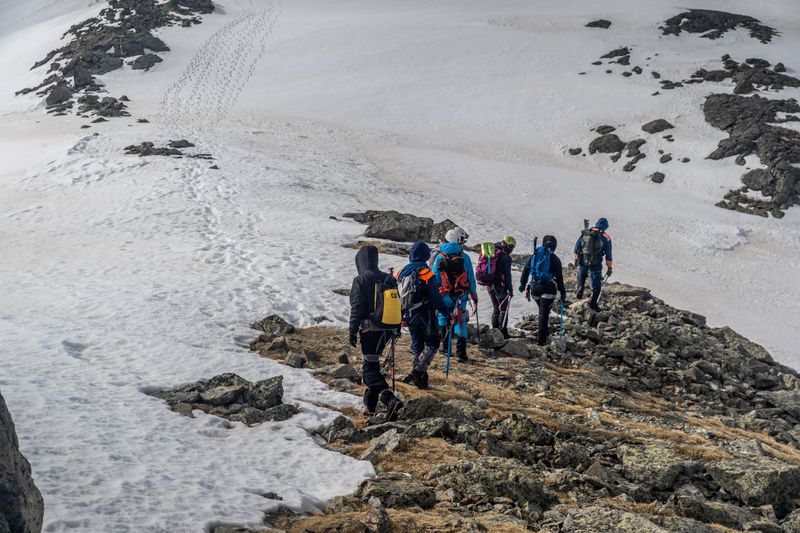
This looks at walking in strong wind from the practical end — what holds up once conditions stop being ideal.
What holds up in practice
- Gust speed rather than mean speed is what knocks people off balance.
- Terrain accelerates wind, so a col or a ridge crest can be far windier than the forecast for the summit.
- Wind removes body heat by stripping the warm air layer next to clothing, independent of air temperature.
What strong wind does to a walking body
Walking is a controlled fall caught by the next step, and wind interferes with that by pushing the body between the moment of falling and the moment of catching. Steady wind can be leaned into and largely ignored; gusts cannot, because the lean that worked a second ago becomes a stumble when the pressure disappears.
The load on the body scales sharply with wind speed rather than in proportion to it, so a modest increase in speed feels like a large increase in force. A pack acts as a sail with its own centre of pressure well above the hips, which is why a loaded walker is destabilised more easily than an unloaded one. The result is that wind converts easy ground into ground requiring attention, and converts exposed ground into somewhere a walker may simply be unable to stand.
Terrain does not just experience wind, it makes it
Air forced over a ridge or through a gap accelerates, so the windiest place on a route is often a col or a crest rather than the highest summit. Valleys aligned with the prevailing flow funnel the air along their length, which is why some approaches are notoriously windy in one direction and calm in the other.
On the ground, behind an obstruction the air becomes turbulent rather than calm, and eddies in a lee slope can arrive from an unexpected direction with no warning. Forecasts describe conditions at a modelled height and a modelled point, so local acceleration by terrain is one of the largest sources of underestimate. Anyone reading a mountain forecast should treat the stated speed as a baseline that specific features on the route will locally increase.
Wind chill is a heat transfer problem, not a temperature reading
Still air held against clothing warms up and forms an insulating layer, and everything a garment does depends on that layer staying in place. Wind strips that layer away and replaces it continuously with cold air, so heat leaves the body far faster than the thermometer suggests it should.
The detail that matters: it also drives air through fabric that is not windproof, which is why a warm fleece can feel useless the moment a shell is removed. Wet clothing multiplies the effect, because evaporation from a damp surface removes additional heat from whatever the surface is touching. The practical consequence is that a windproof outer layer often does more for warmth than a thicker insulating one, particularly on exposed ground.
The things wind takes away besides balance
Speech becomes impossible at conversational volume, so a group loses its main coordination tool at exactly the point it needs it most. Hoods reduce peripheral vision and hearing further, which makes it easy for a party to become spread out without anybody noticing.
The detail that matters: fine motor tasks such as folding a map, operating a zip or handling a compass become slow and clumsy, partly through wind and partly through cold hands. Anything unsecured is likely to leave: maps, hats, gloves, pack covers and rubbish all depart quickly and are rarely recovered.
These effects compound with each other, which is why decisions in strong wind should be made before reaching the exposed section rather than during it.
Reading wind in a forecast
Mountain forecasts usually give both a mean speed and a gust speed, and the gust figure is the one that determines whether standing up is realistic. Speeds are normally given for a stated altitude, so a figure quoted for summit level tells you little about the valley and nothing about a funnelled col. Direction matters as much as speed, because it decides which side of a ridge is sheltered and whether an escape route is into the wind or away from it.
Wind rarely changes alone: a sharp increase usually accompanies a front, which brings its own changes in cloud base, precipitation and freezing level. Specialised mountain weather services exist for many ranges and are worth using in preference to general forecasts, since they model terrain effects explicitly.
The exception is usually weather, which overrides most planning.
Planning around it rather than through it
The most useful habit is having a lower alternative decided in advance, so the choice on the day is between two plans rather than between the plan and failure. Ridges, aretes, summit plateaux and anything above a steep drop are the features where wind converts a nuisance into a serious hazard. Turning back is easier when the decision point is identified beforehand, because deciding while being blown about tends to favour continuing.
Winter adds spindrift and blown snow, which reduce visibility to nothing while the ground underfoot changes, and that combination deserves specific training. Local guidance, recent conditions reports and mountain-specific forecasts should drive these decisions, since no general rule substitutes for knowledge of a particular range.
The takeaway
Decide your wind limit and your alternative route before you leave the valley. Nobody makes good decisions while being pushed sideways.
The route rewards patience more than equipment.
Questions readers ask
At what wind speed does walking become dangerous?
There is no single figure, because it depends on terrain, exposure, body weight, pack size and the ground beneath you. Gusts, exposure and consequence matter more than any number.
Does a heavier pack help in wind?
No. It adds surface area high on the body and increases the leverage a gust can apply. Weight low and close to the back is more stable than weight high.
Why does it feel colder on a ridge than the forecast says?
Because terrain accelerates wind and because wind chill describes heat loss rather than air temperature. Both effects are strongest on exposed crests.