Trails & Routes
Why a walk always takes longer than the distance suggests
Map distance is the smallest part of the calculation. Climb, surface, stops and group size are what actually fill the day.
The points below about estimating walking time are ordered by how much difference they make, not by how often they get repeated.
What matters most
- Map distance is measured flat; the ground you walk is longer and rougher than the line.
- Ascent adds time in a way that is roughly proportional to height gained, not to distance.
- Stops accumulate silently and are the commonest reason an accurate estimate still runs late.
The line on the map is shorter than the walk
Map distance is a horizontal projection, so every metre of climb is quietly discarded before the number ever reaches your planning notes. On steep ground the walked distance can exceed the plotted distance noticeably, and the gap widens with every zigzag a path makes to keep its gradient reasonable. Measuring tools smooth the route further, cutting corners around bends that you will walk in full, which understates a wiggly valley path far more than a straight ridge.
None of this matters on a short outing, but across a full day the accumulated shortfall is measured in kilometres rather than in metres. The habit that fixes it is to treat the measured figure as a floor rather than an estimate, and to plan from the ground you can see on the sheet.
Ascent is the second clock running
Climbing costs time roughly in proportion to height gained rather than distance covered, which is why two routes of equal length can differ by hours. The rules of thumb walkers have used for generations add a fixed time penalty for each unit of ascent on top of a flat walking speed, and they work well enough on paths. They break down on sustained steepness, where the body slows more than the arithmetic predicts and the pauses between efforts stop being optional.
Locally, descent is treated as free by most calculations, which is wrong on rough or steep ground where a careful descent can be slower than the climb that preceded it. Anyone planning a big day is better served by adding a personal correction drawn from past outings than by trusting a formula that has never met their knees.
Surface decides more than gradient does
A firm engineered path and an untracked slope at the same gradient are not the same walk, and the difference compounds over hours rather than over minutes. Deep heather, tussock grass, wet peat and boulder fields all force the leg to lift higher and place each foot deliberately, raising effort and dropping speed at once.
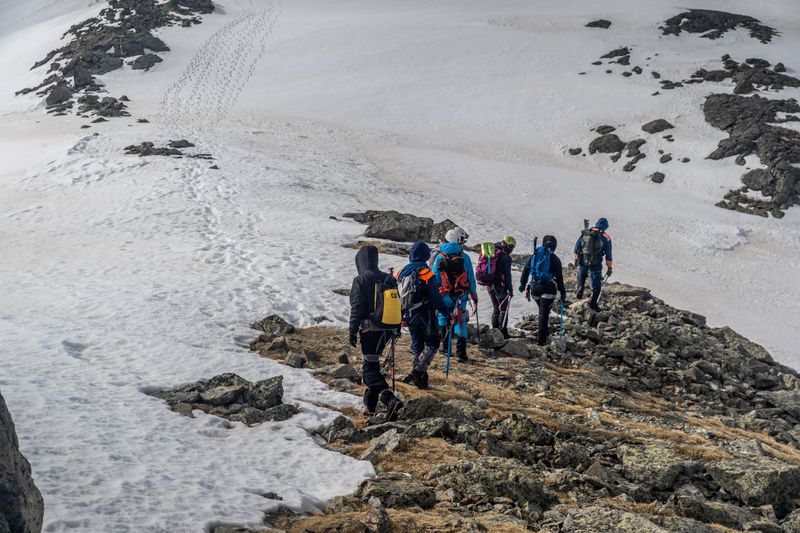
Snow adds its own tax, since walking on a firm crust is fast and breaking through it repeatedly is exhausting in a way that no map records. Soft sand, shingle and loose scree return part of every step to the ground, so progress costs energy that never becomes forward motion. A route description that mentions pathless ground is telling you about time as much as about difficulty, and on a long day those are the same thing.
Stops are the hours nobody counts
Most walkers estimate moving time reasonably well and then arrive late, because the gap is made of stops that never felt long enough to be worth noting. A layer change, a map check, a photograph, a snack and a boot adjustment are each trivial, and a dozen of them across a day is a substantial block of time. Group stops are worse than solo ones, since the party moves again at the pace of the last person to be ready rather than the first.
Locally, long lunches on cold summits cost twice over, because the body cools and the first twenty minutes afterwards are spent rewarming rather than covering ground. Recording actual door-to-door time on a few known routes gives you a personal multiplier that is worth more than any published estimate.
Groups do not scale the way people expect
A large party is slower than its slowest member walking alone, because every stop, gate, stream crossing and navigation decision is multiplied by the number of people present. Narrow ground forces a queue, and a queue moves at the speed of its slowest section rather than at any individual walker's pace. Mixed abilities create a hidden cost, since the fast walkers rest while waiting, the slowest walker arrives, and the party sets off again before that person has recovered.
On the ground, the workable answers are unglamorous: shorter days, deliberate regrouping points and a route whose escape options do not depend on everybody staying strong. Anyone leading a group should plan for the slowest realistic pace and treat any time saved as a bonus rather than as the plan itself.
The exception is usually weather, which overrides most planning.
Building an estimate you can actually trust
Start with measured distance and total ascent, apply whatever rule of thumb you prefer, then add a personal correction learned from routes you have already walked. Add time explicitly for surface, and again for anything the map cannot show, such as pathless ground, river crossings or a section known locally to be awkward. Put stops in as a separate line rather than hoping they fit inside the moving estimate, because that is the assumption that quietly fails every time.
The detail that matters: compare the total against available daylight, remembering that dusk arrives earlier in a deep valley or on an east-facing slope than any published table suggests. Local guidance, recent conditions reports and anyone who has walked the route lately are worth more than any calculation, particularly outside the settled part of the year.
Everything above, in order of what to do first
- The line on the map is shorter than the walk. Map distance is a horizontal projection, so every metre of climb is quietly discarded before the number ever reaches your planning notes.
- Ascent is the second clock running. Climbing costs time roughly in proportion to height gained rather than distance covered, which is why two routes of equal length can differ by hours.
- Surface decides more than gradient does. A firm engineered path and an untracked slope at the same gradient are not the same walk, and the difference compounds over hours rather than over minutes.
- Stops are the hours nobody counts. Most walkers estimate moving time reasonably well and then arrive late, because the gap is made of stops that never felt long enough to be worth noting.
- Groups do not scale the way people expect. A large party is slower than its slowest member walking alone, because every stop, gate, stream crossing and navigation decision is multiplied by the number of people present.
- Building an estimate you can actually trust. Start with measured distance and total ascent, apply whatever rule of thumb you prefer, then add a personal correction learned from routes you have already walked.
The takeaway
Plan the distance, then plan the climb, the surface and the stops. Three of those four are what make you late.
What holds up over a week outdoors is rarely what looks best at the trailhead.
Questions readers ask
Are walking time formulas useless?
No, they are a reasonable starting point on paths and moderate gradients. They simply do not model surface, stops, group size or fatigue, all of which grow across a long day.
Why do descents take longer than expected?
Steep or loose descent requires deliberate foot placement and constant braking by the leg muscles, which is slow and tiring. On rough ground a descent can take as long as the ascent.
What is the single best way to improve my estimates?
Time yourself on routes you know, door to door, including every stop. A personal correction factor from real outings beats any general rule.