Trails & Routes
Boulder fields and scree: moving over ground that moves back
Loose rock is the surface that turns a short distance into a long hour. Reading it is a skill, and so is deciding not to cross it.
These are listed in the order worth acting on, which with loose rocky ground is not the order they are usually presented in.
What matters most
- Lichen cover and embedded soil are useful clues that a block has not moved recently.
- Scree running is fast, hard on the ground and hard to stop once committed.
- In a group, the main hazard on loose ground is other people rather than the rock itself.
Where all this loose rock comes from
Most boulder fields and scree slopes are the accumulated product of frost action, where water freezing in cracks levers rock apart over long periods. The debris collects below the face that produced it, sorted roughly by size, with larger blocks travelling further down the slope than small fragments do.
Some slopes are still actively fed from above and others are relict, dating from colder periods and no longer receiving new material. Active slopes are looser and more mobile; relict ones are often partly vegetated, more settled and considerably easier to cross. Telling the two apart before committing to a crossing tells you more about how the next hour will go than any distance measurement will.
Reading whether a block will move
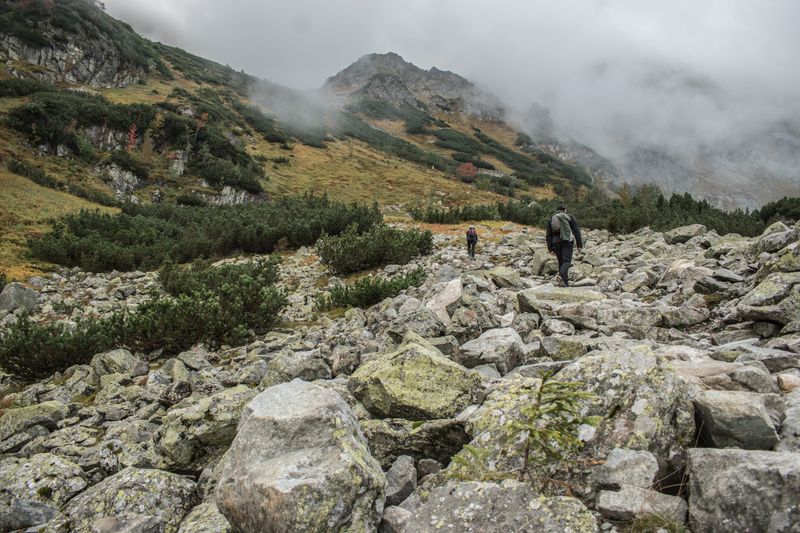
Blocks that interlock with their neighbours are usually stable, while blocks resting on a single point or perched above a gap are usually not. A thick growth of lichen suggests the surface has been undisturbed for a long time, whereas freshly scraped rock and pale scars suggest recent movement. Soil, moss or small plants growing between blocks are a good sign, because they take time to establish and are destroyed by movement.
Wet rock, verglas and snow filling the gaps all change the picture completely, since the clues remain but the friction that made them useful has gone. None of these signs is reliable enough to lean on alone, which is why weight is transferred gradually rather than committed in a single step.
Moving efficiently on big blocks
On boulder fields the efficient line is usually across the tops of the largest blocks rather than down into the gaps between them. Steps are placed on the flattest part of each block and close to where it contacts its neighbours, because the edges are where tipping starts. A steady rhythm with short steps costs less energy than long strides, since long strides require balance corrections that use the small stabilising muscles constantly.
Over a season, poles help on the approach and become a liability among big blocks, where they catch in gaps and occupy hands that would be more useful free. Fatigue is the real hazard, because concentration falls before strength does and most twisted ankles happen in the last third of a crossing.
Scree, and why running down it is contentious
Fine scree can be descended quickly by letting each step slide, which is genuinely fast and remarkably hard on both boots and the slope. The technique only works where the layer of loose material is deep; where it is thin over bedrock, the same movement becomes an uncontrolled slide.
Stopping is the difficulty, since momentum builds quickly and there is often nothing to grab, which is why the run-out below matters more than the slope itself. It also strips the slope: repeated descents concentrate movement into a channel, remove the finer material and expose an unpleasant surface for everyone afterwards. Many upland areas now discourage the practice for that reason, and local guidance should be checked rather than assumed to permit it.
The hazards that are not obvious from above
Vegetated boulder fields hide their gaps, so a step onto what looks like heather can drop a leg into a hole between blocks. Snow bridges the same gaps and produces a smooth surface with voids underneath, which is a well-known cause of injury early and late in the season.
Water running beneath a block field is common in mountains and can be heard without being seen, and it indicates substantial space below the surface. Slopes below crags may receive rockfall, which is more likely during thaw, after heavy rain and in the hours when frozen ground begins to release. Any of these can be assessed only on the ground and in current conditions, which is why local information is more useful than a route description written years ago.
The exception is usually weather, which overrides most planning.
Groups on loose ground
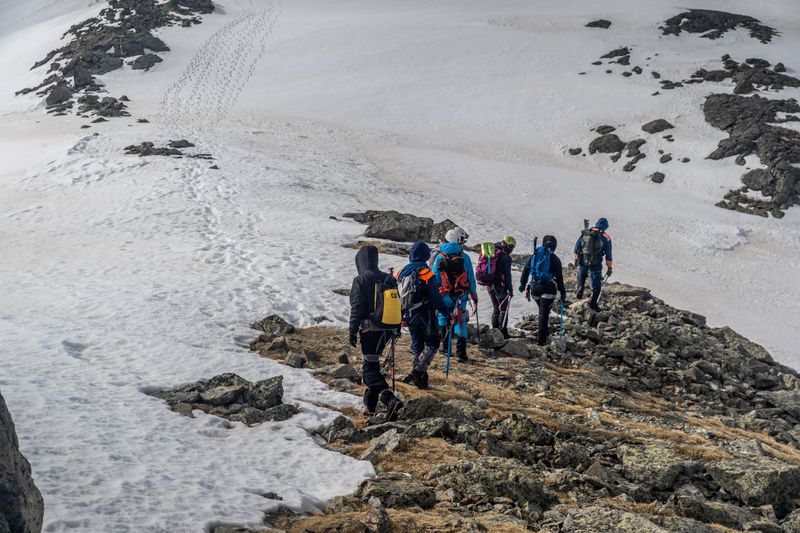
The single largest hazard on scree is other people, since anything dislodged travels downhill and gathers speed as it goes. Spreading a group horizontally so nobody is directly below anybody else removes most of that risk and costs nothing but a little coordination. Where the ground forces a single line, keeping the party close together means a dislodged stone has little distance in which to accelerate.
Locally, helmets are standard practice for scrambling and climbing parties on such ground, and walkers crossing beneath crags increasingly borrow the habit. A shouted warning is the accepted convention almost everywhere, and knowing the local word for it is a small courtesy worth learning before travelling.
Everything above, in order of what to do first
- Where all this loose rock comes from. Most boulder fields and scree slopes are the accumulated product of frost action, where water freezing in cracks levers rock apart over long periods.
- Reading whether a block will move. Blocks that interlock with their neighbours are usually stable, while blocks resting on a single point or perched above a gap are usually not.
- Moving efficiently on big blocks. On boulder fields the efficient line is usually across the tops of the largest blocks rather than down into the gaps between them.
- Scree, and why running down it is contentious. Fine scree can be descended quickly by letting each step slide, which is genuinely fast and remarkably hard on both boots and the slope.
- The hazards that are not obvious from above. Vegetated boulder fields hide their gaps, so a step onto what looks like heather can drop a leg into a hole between blocks.
- Groups on loose ground. The single largest hazard on scree is other people, since anything dislodged travels downhill and gathers speed as it goes.
The takeaway
Loose ground is a decision before it is a technique. Look at the slope, look at the run-out, then decide whether to be on it at all.
The route rewards patience more than equipment.
Questions readers ask
How can I tell if a boulder field is stable?
Lichen growth, soil and plants between blocks, and blocks that interlock rather than perch all suggest stability. Treat every sign as provisional and transfer weight gradually.
Is scree running acceptable?
It depends where you are. It accelerates erosion and concentrates damage, and some areas actively discourage it. Check local guidance for the specific place.
Why do so many ankle injuries happen on descent?
Loose ground demands constant fine adjustment, concentration falls with fatigue, and descending adds speed to any misplaced step.