Trails & Routes
Descending is what actually injures people
Most walking injuries and most fatigue arrive on the way down, and the technique is different from going up.
This looks at descending technique from the practical end — what holds up once conditions stop being ideal.
What holds up in practice
- Descending loads muscles eccentrically, which causes most post-walk soreness.
- Poles reduce load through the knees substantially on steep ground.
- Fatigue and inattention on descent account for a large share of incidents.
The muscle work is different
Going uphill shortens muscles under load; going down lengthens them under load, which is eccentric contraction. Eccentric work causes more muscle damage and is the main reason legs hurt for days after a big descent. It is also trainable specifically, which is why people who walk downhill regularly suffer far less.
The soreness arrives late as well, peaking a day or two after the effort, so a big descent on the first day of a trip does its worst on the third — which makes the schedule matter as much as the technique.
Knees take the force
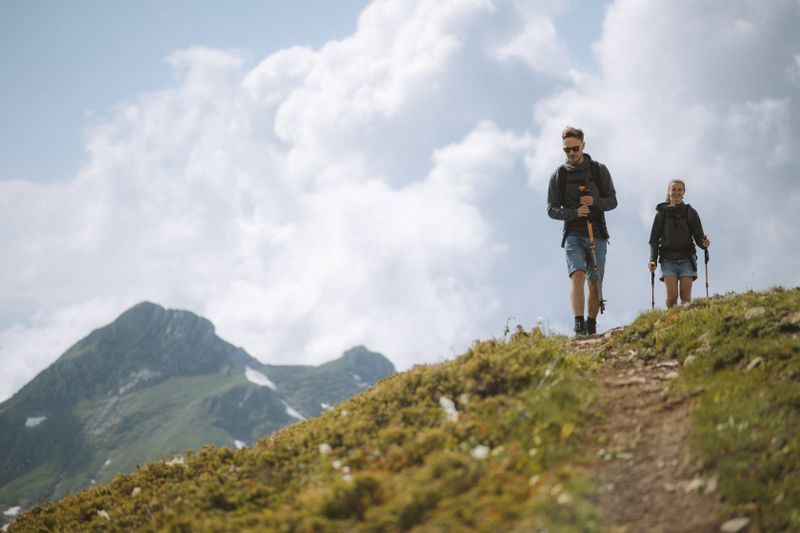
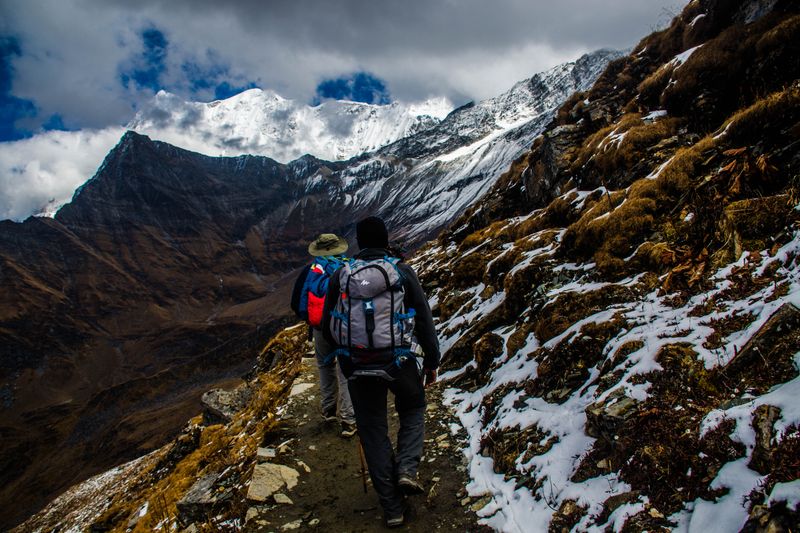
Force through the knee on a steep descent is several times body weight, multiplied by every step. Poles used properly transfer a meaningful share of that to the arms and shoulders.
The benefit is largest exactly where it is most needed, on long steep descents with a loaded pack. That force scales with total mass, so a kilo taken out of the pack is felt several times over at every step down, which is why the case for a lighter load is strongest on the descent rather than on the climb it was bought for.
Technique reduces impact
Shorter steps, a slightly bent knee on landing and keeping the weight over the feet all soften the load. Locking the leg straight on each step transmits shock directly through the joint.
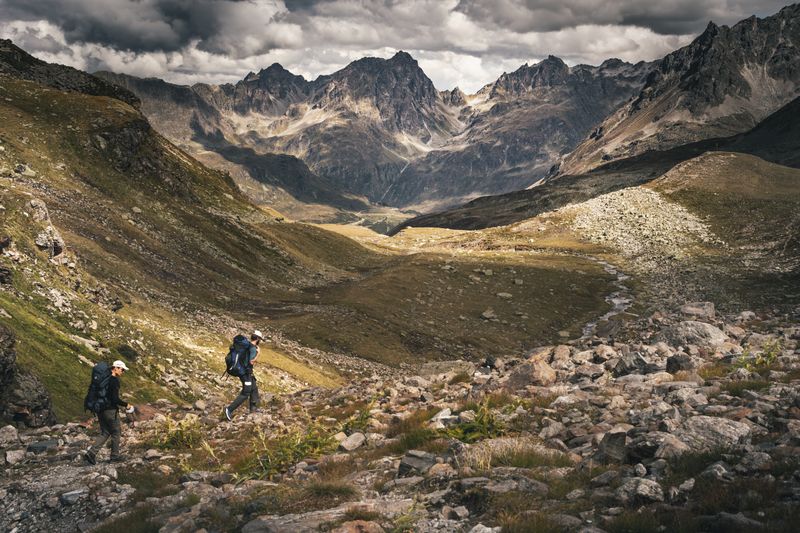
Zigzagging on steep loose ground is easier on the body and on the path surface. Looking two or three steps ahead rather than straight down is the other half of it, because that is what lets you choose where each foot lands while there is still time to change your mind, and it separates a fluid descent from a series of corrections.
Attention fades at the wrong time
The descent typically comes at the end of the day, when concentration and coordination are lowest. A large share of walking incidents happen on descent for exactly this reason, and most are slips rather than falls from height. Recognising that the last hour is the dangerous one changes how carefully it is walked.
The detail that matters: treating the top of a descent as a scheduled stop — eat something, drink, tighten laces, set the poles — costs five minutes and buys back a good deal of the concentration the climb has just spent.
Preparing for it
Downhill-specific training — walking down stairs or hills deliberately — reduces soreness substantially within a few weeks. Trimming toenails before a long descent prevents a specific and very common complaint.
Boots that allow the foot to slide forward will bruise toenails regardless of technique, which is a fit problem. Downhill training has to be built up gradually like anything else, because the eccentric loading that produces the adaptation is the same loading that produces the damage, and a sudden programme of hard descents does more harm than the walks it was meant to prepare for.
That varies by region, and it is worth checking locally.
Surfaces change everything on the way down
Wet grass on a steep slope is among the most consistently underestimated hazards in hill country, because it gives no warning underfoot and soles built for rock and mud grip it poorly. Loose scree descends easily and tears the slope apart, which is why many well-known scree runs have been closed or rerouted; where a made path runs alongside the loose ground, using it is the difference between a route surviving and washing into the valley.
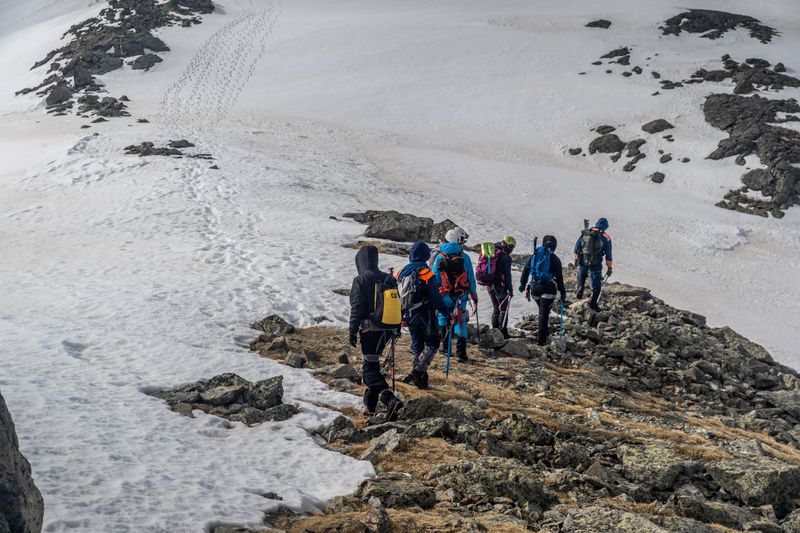
Old snow lying across a path late in the season is hard, frequently refrozen overnight and steepens out of sight below, and a slip on it accelerates far faster than people expect. Crossing that kind of snow safely needs an ice axe and a practised self-arrest, which is a winter skills course rather than something to attempt for the first time mid-descent; turning back is the alternative and is an entirely ordinary outcome.
The takeaway
Slow down for the descent. It is where the day gets expensive.
Go slowly enough to notice, and most of this stops being advice and starts being obvious.
Questions readers ask
Do poles really help?
On descent, measurably. Studies have found meaningful reductions in knee loading and in perceived exertion, and the effect is largest with a heavy pack.
Why do my toenails go black?
The foot is sliding forward and hitting the toe box on descent. Usually a lacing or sizing problem rather than an inevitability.
Also by Imogen Vasse
- Crofting, commons and the land nobody quite ownsPeople & Place
- Walking in heat is a different sport, and the rules are strictTrails & Routes
- Blisters are a friction problem, not a toughness problemTrails & Routes
- Wild camping law varies enormously, and assumptions travel badlyTrails & Routes