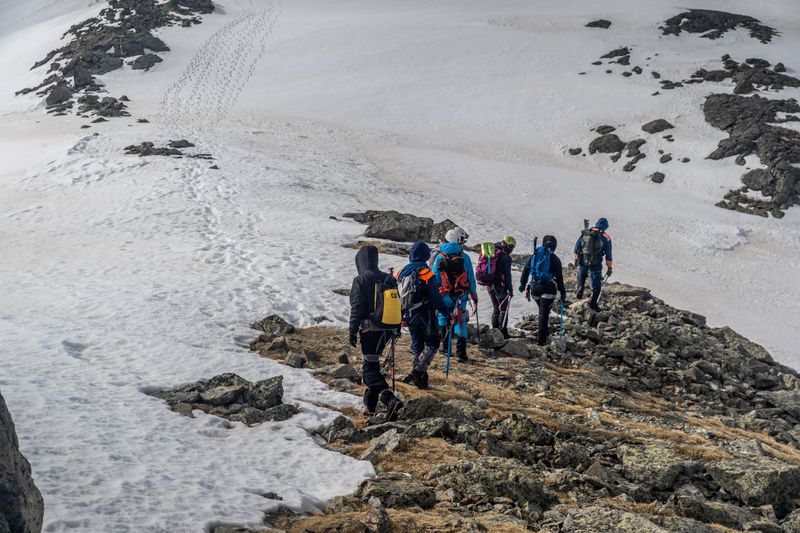
Trails & Routes
Wild camping law varies enormously, and assumptions travel badly
What is a right in one country is a trespass in the next, and the etiquette differs even where the law does not.
There is a settled way of talking about wild camping rules. It is worth asking how much of it survives contact with the detail.
The argument in brief
- Access rights differ sharply between neighbouring countries.
- Where it is permitted, it is usually conditional on how you camp.
- Local pressure has closed areas that were open a decade ago.
The legal position is national, not intuitive
Some countries have a broad right of responsible access that includes camping; others treat it as trespass without landowner permission. Neighbouring countries frequently differ, and assumptions carried across a border are the usual source of trouble. Checking the specific national position before a trip takes minutes and is genuinely necessary.
It is frequently not even national, since federal states, regions, individual national parks and sometimes single municipalities set their own rules, so the correct answer for a country can be the wrong one for the valley you are standing in.
Permission is often conditional
Where camping is permitted it is usually subject to conditions: away from buildings and roads, small groups, one or two nights, no fires. Those conditions are the substance of the right rather than a courtesy attached to it. Ignoring them is what produces the local bans that follow.
The conditions recur in recognisable forms: a stated distance from roads, dwellings or water, an altitude above which it is permitted and below which it is not, a cap on party size, and a maximum of one or two nights in the same spot.
The practice that keeps it open
Arrive late, leave early, pitch out of sight of paths and houses, take everything out including food waste, and leave no trace of the pitch. Human waste buried properly and well away from water is the part most often done badly. Fires are the single most damaging common behaviour and are prohibited in most places where camping is not.
Over a season, burial only works where there is soil biology to do the work, so on thin alpine ground, on snow and in desert the convention has moved to carrying it out, which is now a stated requirement on several heavily used routes and permit systems.
Pressure has closed places
Several popular areas have introduced byelaws or permit schemes after damage, litter and fire risk from concentrated camping. These were generally responses to visible harm rather than to camping in principle.
Checking for local restrictions specifically, rather than relying on the national rule, is now worth doing. The alternative that has spread instead of an outright ban is a permit system with a nightly quota, which keeps camping legal and makes it plannable while removing the spontaneity that was much of the point of it.
Alternatives worth knowing
Basic campsites, farm pitches and bothies exist in many areas and cost little. In some countries a network of designated wild sites or shelters provides a legal middle ground. Where the law is restrictive, asking a landowner directly is more often successful than people assume.
In practice, several countries also maintain free designated sites with a fire ring, a shelter and a toilet — the Nordic lean-to and the state forest camp are the familiar versions — and using one is usually a better night than a hidden pitch as well as an uncomplicated one.
Bivouac and camping are different words in law
Several Alpine countries prohibit camping in the high mountains while tolerating a bivouac: no tent at all, or a tent pitched after dusk and struck at first light, for a single night. The distinction exists so that a party benighted on a long route can stop safely without that creating a general right to pitch for a week.
Over a season, elsewhere the two are not separated at all, and some national parks expect even an emergency bivouac to be reported or permitted in advance. It is worth finding out which word the local rules use, because what is permitted is often defined that precisely — down to the hour you put the poles up and whether you used any.
The takeaway
Check the national rule, then check the local byelaw. They are frequently different.
The route rewards patience more than equipment.
Questions readers ask
Can I camp anywhere in a national park?
Rarely. Designation as a national park does not confer camping rights, and several parks have specific restrictions in busy areas.
What about camping beside a road?
Almost universally prohibited or discouraged, and it is the behaviour most likely to prompt a local ban. Walk in.
Also by Imogen Vasse
- Crofting, commons and the land nobody quite ownsPeople & Place
- Walking in heat is a different sport, and the rules are strictTrails & Routes
- Blisters are a friction problem, not a toughness problemTrails & Routes
- Pacing uphill: the conversation test beats any heart rate zoneTrails & Routes