Trails & Routes
Pacing uphill: the conversation test beats any heart rate zone
Sustainable climbing pace is set by whether you can still speak in sentences, and almost everyone starts above it.
Comparisons of walking pace on climbs usually pick a winner. This one picks the circumstances, which is more useful.
The difference in one place
- The aerobic threshold is roughly where speech becomes broken.
- Going above it early costs more time later than it saves.
- Rest step and short strides preserve pace on steep ground.
Speech is a usable gauge
Below the aerobic threshold most people can talk in full sentences; above it speech breaks into short phrases. That transition is a reasonable field proxy for the pace you can hold for hours rather than minutes. It requires no watch, works at any fitness level and adjusts automatically for altitude and load.
It works less well alone, where the substitute is simply to say something out loud — count to twenty, recite anything — because what matters is whether you can produce a continuous sentence rather than whether anyone is listening to it.
Starting too fast is the universal error
The first climb of the day feels easy because you are fresh, and the pace set there is usually unsustainable. The cost arrives two hours later as a disproportionate slowdown, and the average speed ends up lower.
Deliberately starting slower than feels natural is the single most reliable way to arrive earlier. The mechanism is fuel, since working above the threshold burns a much larger share of stored carbohydrate for the same distance covered, and the slowdown two hours later is that store running down rather than the legs simply tiring.
Short strides on steep ground
Raising your centre of mass is the work; a longer stride raises it further per step and loads the legs harder. Shortening the stride and increasing cadence keeps the effort continuous rather than a series of lunges. On very steep ground the rest step — locking the rear leg briefly each stride — transfers load to bone rather than muscle.
On built stone steps the same principle says to take the low step rather than the obvious one, because a path built to a comfortable gradient still offers a choice of step heights and consistently choosing the smaller keeps the effort even.
Stopping has a cost
Frequent short stops break rhythm and cool you down, and restarting is disproportionately expensive. A steady slow pace with occasional planned stops beats a fast pace with constant unplanned ones. Most experienced walkers take fewer, longer breaks rather than many short ones.
Locally, a stop is also where the day is preserved or lost, because putting a layer on before you cool, eating before you are hungry and drinking before you are thirsty all have to happen in those few minutes or they do not happen at all.
Groups need a stated pace
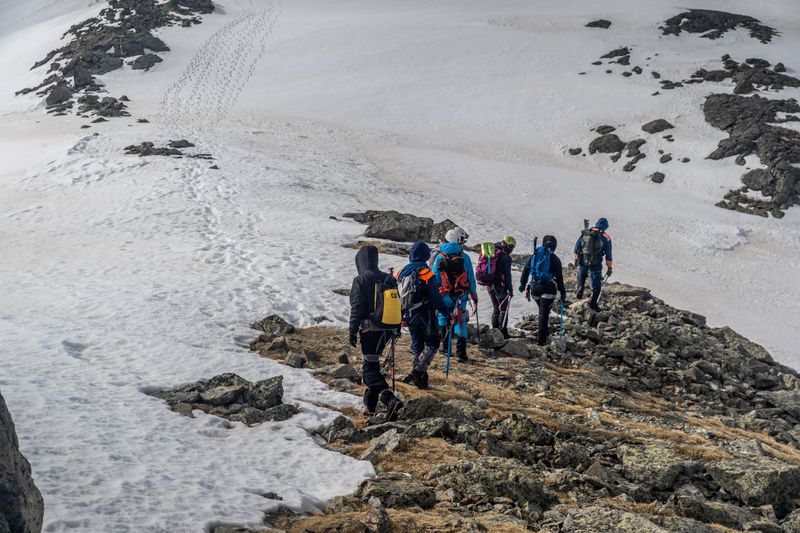
A group naturally walks at the pace of its most enthusiastic member, which is rarely the sustainable one. Putting the slowest walker at the front is the standard fix and works. Agreeing this at the trailhead avoids a conversation that is much harder to have three hours in.
The other convention that works is regrouping at agreed features rather than at intervals, since everybody then knows where the next stop is and the faster walkers wait somewhere useful instead of wherever they happened to notice the gap.
None of this is uniform across a country the size of most of these.
Turning pace into a time estimate
The oldest working rule allows about an hour for every five kilometres on the flat plus an extra half hour for every three hundred metres of ascent, and it has survived because it is close enough to plan from. It assumes a reasonably fit party on a good path in good conditions carrying very little, which is why real days routinely overrun the arithmetic by a wide margin. The standard corrections add time for a heavy pack, rough or pathless ground, poor visibility, snow cover and for each hour already walked, and experienced parties carry a personal multiplier worked out from days they actually timed.
Descent is what the rule handles worst, since gentle descent is faster than flat ground while steep descent is slower, so any route with a large drop needs its estimate checked against experience rather than against the formula.
Side by side
| Consideration | What it means in practice |
|---|---|
| Speech is a usable gauge | The aerobic threshold is roughly where speech becomes broken. |
| Starting too fast is the universal error | Going above it early costs more time later than it saves. |
| Short strides on steep ground | Rest step and short strides preserve pace on steep ground. |
The takeaway
If you cannot speak a full sentence, you are walking tomorrow's pace today.
What holds up over a week outdoors is rarely what looks best at the trailhead.
Questions readers ask
Should I use a heart rate monitor?
It is useful if you know your own zones, and the conversation test gets most walkers to the same place without hardware or calibration.
How often should we stop?
Fewer and longer generally beats frequent and short. Many parties settle on a proper stop every couple of hours plus brief adjustments as needed.
Also by Imogen Vasse
- Crofting, commons and the land nobody quite ownsPeople & Place
- Walking in heat is a different sport, and the rules are strictTrails & Routes
- Blisters are a friction problem, not a toughness problemTrails & Routes
- Wild camping law varies enormously, and assumptions travel badlyTrails & Routes