Wild Places
Sky Islands Stack Climate Zones On One Mountain
Isolated desert mountain ranges in the American Southwest hold forest communities separated from each other by lowland desert, making each summit an island for the species living there.

In the deserts of the Southwest, isolated mountain ranges rise steeply from arid basins. Climbing one crosses a sequence of habitats that would otherwise require traveling a great distance north.
Elevation substitutes for latitude
Temperature falls and precipitation rises with height, so a few thousand feet of climb reproduces the climatic change found over hundreds of miles of northward travel.
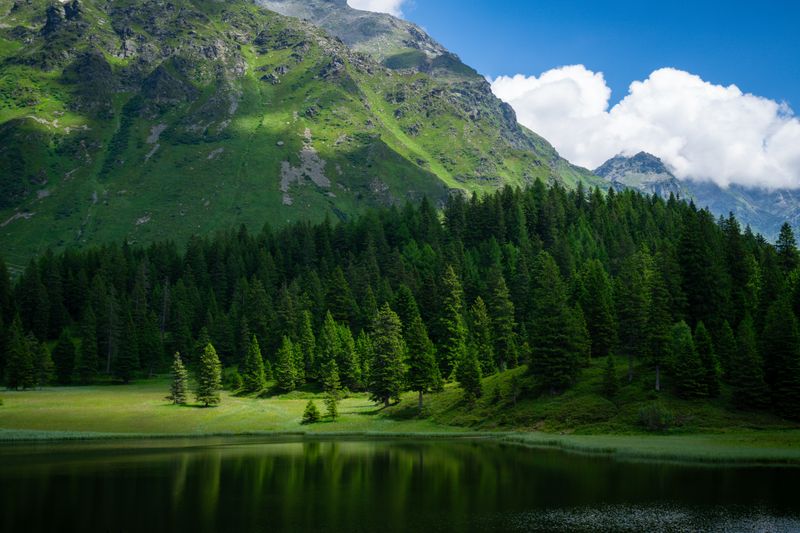
The result is a stack of bands: desert scrub, then grassland and oak, then pine, then fir and spruce near the top, each with its own community of plants and animals.
A single day's walk can pass through all of them, which is why these ranges concentrate so much biological variety in a small area.
The lowlands are the barrier
For a squirrel or salamander adapted to conifer forest, the surrounding desert is impassable. The forest on the next range may as well be across an ocean.
That isolation produces populations that have been separated long enough to diverge, and some ranges hold subspecies found nowhere else.
Birds and flying insects cross more readily, which is why bird diversity in these ranges is high while ground-dwelling species are more localized.
The islands are shrinking upward
As the climate warms, the elevation at which a given community can persist rises, and the band available to high-elevation species narrows toward the summit.
A species already confined to the top of its range has nowhere further to go, which is the specific vulnerability of an island in the sky.
The pattern is measurable through repeated surveys of the same slopes over long periods, comparing where species are found now against historical records.
Fire behaves differently on each band
Lower grassland and oak woodland historically burned frequently and lightly, while the highest forest burned rarely and severely. Suppression altered both.
Fuel accumulation in the middle bands allows fire to reach the top with an intensity the high forest is not adapted to survive.
A severe fire in a small summit forest can remove the entire habitat of an isolated population in a single season, with no adjacent source to recolonize from.
Water on these ranges is disproportionately important
Springs and small perennial creeks on sky islands support amphibians, fish and riparian plants in a region where surface water is otherwise almost absent.
Those sources depend on snowpack and on groundwater in fractured rock, both of which respond to changes in the seasonal pattern of precipitation.
Because so much wildlife concentrates at these points, small disturbances at a single spring can affect far more than the area they occupy.
Questions readers ask
Is deadwood a fire or disease risk?
Standing and fallen deadwood in woodland is habitat rather than hazard in most temperate conditions. Safety pruning near paths is a separate and legitimate matter.
How can I help record ancient trees?
National tree inventories accept public records with photographs, girth measurements and locations, and are largely volunteer-built.