Wild Places
Montane heath is the habitat above the tree line nobody names
The dwarf shrubs and lichen heaths of high plateaux are Arctic vegetation stranded at low latitude, and they are retreating.
This is less a set of instructions about montane heath than an argument, and it is worth saying so at the start.
The argument in brief
- Montane heath is Arctic vegetation persisting at high altitude in temperate latitudes.
- It depends on late snow lie and exposure that excludes competitors.
- Warming reduces the snow beds these communities need.
Arctic vegetation in the wrong latitude
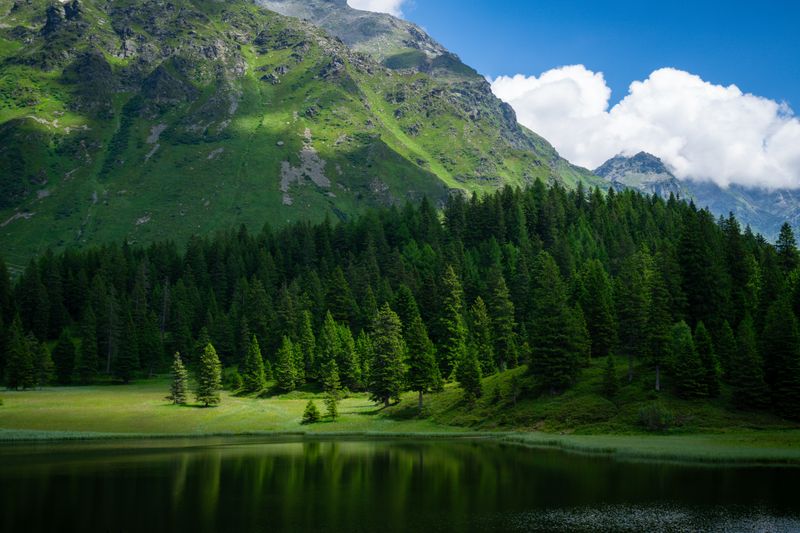
Above the tree line, high plateaux carry dwarf shrub, moss and lichen communities closely related to those of the Arctic tundra. They persist because altitude reproduces the exposure, cold and short season of far higher latitudes. They are relicts of colder periods rather than a local variant of lowland heath.
The tree line itself sits lower in these ranges than climate alone would place it, held down by wind, by centuries of grazing and by burning, so the bottom edge of the zone is partly a human artefact even where the top of it is not.
Snow lie defines the communities
Where snow lies late into the season, distinct snow-bed communities develop, dominated by mosses and specialised small plants. These need both the insulation of winter snow and the short growing season that follows. Their distribution maps closely onto where snow persists, which makes them unusually sensitive to change.
Over a season, snow protects as well as delays, insulating the vegetation beneath it from ice blast and the hardest frosts, so a winter without it exposes those plants to conditions the community never had to tolerate rather than simply handing them a longer season.
Exposure keeps competitors out
Wind, ice blast and thin soils exclude the vigorous grasses and shrubs that would otherwise dominate. Where shelter increases or nutrients arrive, coarser vegetation moves in quickly.
Trampling that breaks the surface mat can start that process and takes decades to recover. The mat is shallow-rooted on very thin soil, so once it is torn the wind gets underneath and strips the exposed ground, which is why a scar on a plateau keeps widening long after the feet that started it have gone.
Climate is squeezing them upward
As conditions warm, the altitude at which these communities can persist rises, and on most hills there is no higher ground to move to. Reduced snow cover affects the snow-bed communities first and most sharply.
This is the clearest example in temperate uplands of a habitat with nowhere left to retreat to. It is being measured rather than assumed, through networks of fixed plots on summits across several continents that are recensused on a long cycle, and those are the datasets that will show the change while it is still happening.
Walking on it
Plateau vegetation is slow-growing and recovers from damage over decades rather than seasons. Where paths exist across plateaux, staying on them matters more than in almost any other terrain. Camping on late snow beds and lichen heath does damage that will still be visible in twenty years.
Where there is no path, the ground to choose is stone, gravel or snow rather than vegetation, and a party crossing a plateau does far less harm walking in single file on one line than spreading out across the moss.
The animals that live nowhere else
The plateau carries a short list of specialists — ptarmigan, dotterel, snow bunting and a set of Arctic-alpine invertebrates among them — that are tied to this zone rather than merely turning up in it. Several of them nest directly on open ground among the lichen and moss, with no cover and no structure to give the position away, which makes a nest effectively invisible until somebody has stepped on it. Ptarmigan moult to white for a snow cover that now arrives later and clears earlier, leaving them conspicuous to predators for longer each year through a mechanism no visitor behaviour affects either way.
Where a plateau also carries ski infrastructure or heavy summer footfall, disturbance and discarded food that draws crows and gulls up onto the tops compound all of it, which is why plateau reserves ask so insistently for dogs on leads and litter carried down.
The takeaway
It is Arctic vegetation with nowhere higher to go. Stay on the path.
What holds up over a week outdoors is rarely what looks best at the trailhead.
Questions readers ask
Where does montane heath occur?
On high plateaux above the natural tree line — in Britain principally the Cairngorms and a few other high massifs, and widely across Scandinavian and Alpine uplands.
Why does it matter if it is only lichen and moss?
These communities support specialised invertebrates and breeding birds found nowhere else, and they cannot relocate upward once they are already at the summit.