Trails & Routes
Why Paths Widen And What That Does To A Hillside
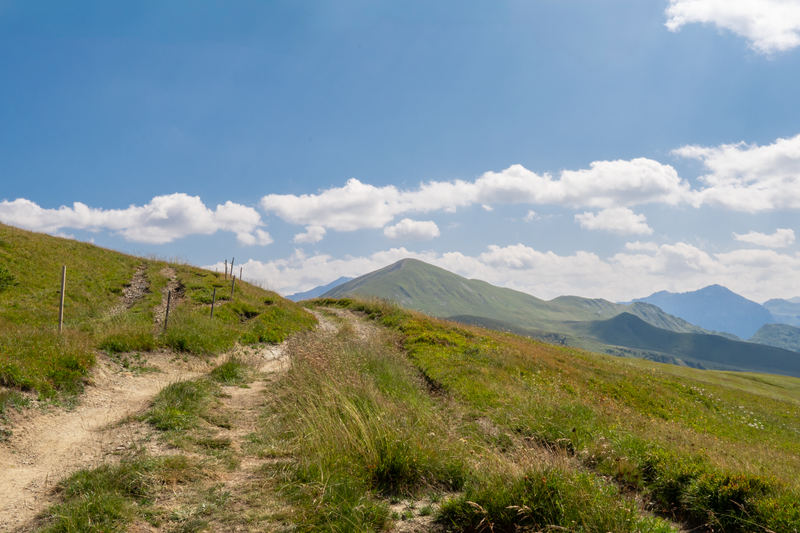
A trodden line spreads sideways when its centre becomes unpleasant to walk on, and the widening damages far more ground than the original path ever did.

A path a metre wide can become a bare scar many metres across without any increase in the number of people using it. The mechanism is avoidance rather than volume.
Walkers move to the edge of discomfort
Where the centre of a path becomes wet, rutted or loose, people step onto the vegetated margin, which is drier and easier. Each does so individually and reasonably.
That margin is then trodden, loses its vegetation and becomes the new wet ground, so the next walkers move a step further out.
The process is incremental and has no natural stopping point. It continues until the ground is dry enough or hard enough to walk on, which on peat may mean many metres.
The trigger is usually drainage
A path becomes unpleasant when water sits on it. That happens where the surface is compacted below the surrounding ground, so the path acts as a channel.
Compaction is unavoidable with traffic, so the difference between a stable path and a spreading one is whether water is being taken off it.
This is why maintenance effort concentrates on drainage rather than surfacing, and why a well-drained path carrying heavy traffic can stay narrow while a lightly used one spreads.
Damage is disproportionate to the width
A narrow path is a line through a habitat and has limited effect. A wide scar removes vegetation across an area and exposes soil to wind and water.
On upland peat and thin mountain soils, exposure means loss. Once the vegetation mat is broken the material beneath erodes rapidly and does not recover on any useful timescale.
The visual effect on a hillside is out of proportion as well, and it is the most common reason a popular route becomes the subject of a repair appeal.
Repair means making the line attractive again
Restoration works by giving walkers a surface they prefer, then allowing the margins to recover. If the constructed path is unpleasant, people continue to walk beside it.
This is why repaired paths are sometimes criticised as over-engineered. A surface that stays dry and firm is what keeps traffic on the line, and a modest repair frequently fails for that reason.
Recovery of the surrounding ground is slow and often assisted with matting, seeding or transplanted turf, and it is the part of the work with no visible result for years.
Routing avoids the problem where it can
The most durable answer is to align a path where the ground can take it: on mineral soil, on rock, along a slope rather than up it, and away from ground that holds water.
Where a popular route crosses unavoidably fragile ground, boardwalk or floating stone is used instead, on the reasoning that carrying the traffic above the surface is cheaper than repairing it repeatedly.
Questions readers ask
Do I need to break in modern boots?
Most trail shoes need little breaking in; your feet still need conditioning. Walk in the exact shoes and socks you will use, at the load you will carry.
Are double-layer socks worth it?
For people who blister reliably, often yes — they move the shear between the sock layers rather than against skin. They are warmer and bulkier, which suits some conditions and not others.
Also by Imogen Vasse
- Crofting, commons and the land nobody quite ownsPeople & Place
- Walking in heat is a different sport, and the rules are strictTrails & Routes
- Wild camping law varies enormously, and assumptions travel badlyTrails & Routes
- Pacing uphill: the conversation test beats any heart rate zoneTrails & Routes