Trails & Routes
Switchbacks Exist For The Path, Not For The Walker
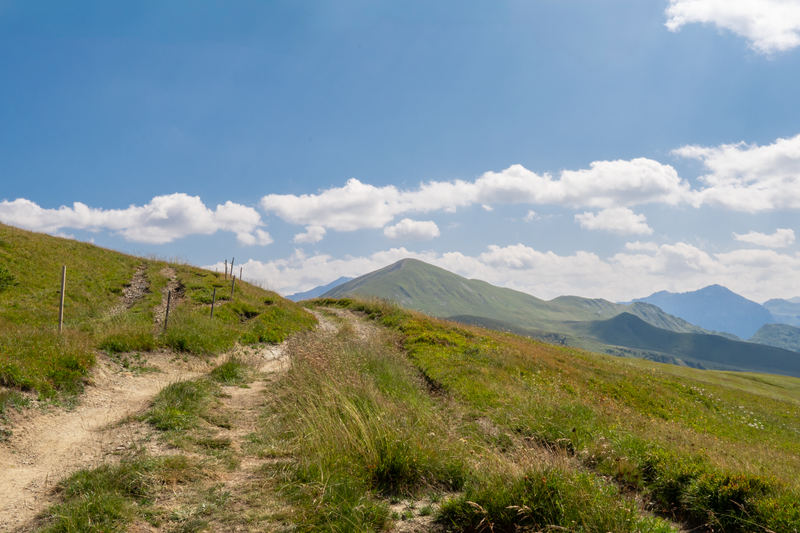
Zigzags up a slope look like a concession to tired legs, but their real function is keeping water off the trail surface and stopping the hillside washing away.
Walkers cutting the corner off a zigzag assume the zigzag was built to make the climb easier. It was built to stop the path becoming a stream.
A straight path up a slope becomes a watercourse
A trail running directly up a hillside offers water the steepest available route down. Rain concentrates in the compacted channel and accelerates.
Moving water carries material, and the faster it moves the larger the particles it can shift. A direct line therefore erodes into a gully within a small number of seasons.
Once a gully forms it deepens, because it collects more water than the surrounding ground. The process is self-reinforcing and stops only when bedrock is reached.
Traversing keeps gradient below the erosion threshold
Path builders work to a maximum gradient, typically well below the slope of the hillside, chosen so water on the surface moves slowly enough not to carry material.
Achieving that on a steep hillside means the path must travel a long way sideways for every metre of height, which is what produces the zigzag.
The turns are the expensive part. Each one is a place where water wants to leave the path and where the structure has to be built up and drained deliberately.
Cutting the corner starts a new gully
A shortcut between two legs of a zigzag is a straight line down the fall line, which is exactly the alignment the design was avoiding.
Vegetation goes first, then soil, and within a season or two there is a visible scar that channels water directly from the upper leg to the lower one.
That water then attacks the constructed path where it crosses, so a shortcut damages three things at once: the new line, the drainage and the path itself.
Drainage features are the actual engineering
The visible surface is the least of a built path. Cross-drains, water bars and the camber that sheds water sideways are what determine how long the surface lasts.
These features need clearing. A blocked drain sends water down the path instead of off it, and a single blocked drain can undo a season of work in one storm.
This is why maintenance parties spend much of their time digging out channels that look like nothing rather than laying new stone.
The alternative is a much wider path
Where erosion is allowed to proceed, walkers move to the edges to avoid the gully, and the trodden width grows steadily until a metre-wide path is ten metres of bare ground.
Repairing that costs far more than building the original, and on thin upland soils the vegetation may take decades to return even after the traffic is removed.
Questions readers ask
Do I need to break in modern boots?
Most trail shoes need little breaking in; your feet still need conditioning. Walk in the exact shoes and socks you will use, at the load you will carry.
Are double-layer socks worth it?
For people who blister reliably, often yes — they move the shear between the sock layers rather than against skin. They are warmer and bulkier, which suits some conditions and not others.
Also by Imogen Vasse
- Crofting, commons and the land nobody quite ownsPeople & Place
- Walking in heat is a different sport, and the rules are strictTrails & Routes
- Wild camping law varies enormously, and assumptions travel badlyTrails & Routes
- Pacing uphill: the conversation test beats any heart rate zoneTrails & Routes