Trails & Routes
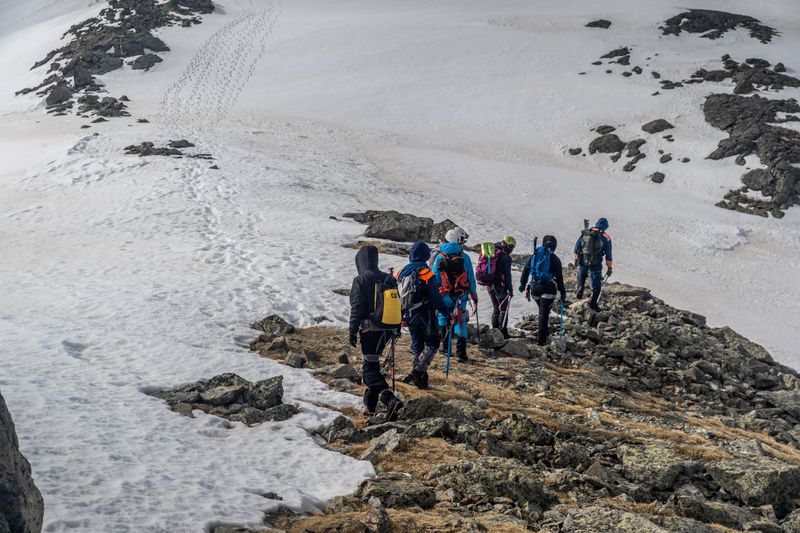
Snow on a path changes the grade of a walk entirely
A summer route with snow lying on it is a different objective requiring different equipment and different judgement.
Everything below about walking on snow comes from what actually happens rather than from what is supposed to.
What holds up in practice
- Old consolidated snow is harder than it looks and does not allow kicked steps.
- A slip on a snow slope accelerates faster than people expect.
- Runout matters more than gradient when judging a snow slope.
Snow is not one surface
Fresh soft snow allows kicked steps and is tiring rather than dangerous on moderate ground. Consolidated or refrozen snow is effectively ice and will not take a boot edge without crampons. The same slope can be one and then the other within a few hours of sun or a temperature drop.
The test is cheap: kick a step and see whether the boot bites or skates, remembering that kicking steps at all requires a sole stiff enough to hold an edge, which most flexible walking shoes simply are not.
Slips accelerate fast
A slip on a snow slope reaches speeds that make self-arrest difficult within a couple of seconds. Self-arrest with an axe is a trained skill that degrades without practice, and it fails on hard snow.
Worth knowing before you go — assuming you will stop yourself is the assumption that produces winter accidents. Poles in both hands are the specific trap, because they cannot arrest a slide and they occupy the hands that should be holding an axe, so the swap from poles to axe has to happen before the ground demands it rather than during the slip.
Judge the runout first
The question is not how steep the slope is but what is below it — a gentle runout onto flat snow, or rocks, or a drop. A modest slope above a cliff is a serious proposition; a steep slope above a flat basin is not.
Experienced winter walkers look downhill before they look up. The runout also changes through the day, since a bowl soft enough to stop you at four in the afternoon is refrozen and frictionless at eight the next morning, and the slope itself has not changed at all.
Equipment is not optional once conditions change
Crampons and an axe are the equipment for hard snow, and carrying them without knowing how to use them is close to useless. Winter skills courses are widely available and are the single best investment for anyone walking hills in winter.
Worth knowing before you go — microspikes handle frozen paths and icy tracks and are not a substitute for crampons on steep snow. The harder discipline is putting it on early, because crampons are fitted standing on flat ground at the foot of a slope rather than balanced halfway up one, and a great many incidents involve somebody who had the equipment in the pack.
Turning back is the normal outcome
Conditions in winter change faster and the margin for error is smaller. A route that was straightforward in October is a different objective in February, and treating it as the same walk is the underlying error.
Winter days are also short, which compresses every other decision. Existing footprints are their own trap, since a line of tracks tells you somebody went that way and nothing whatever about whether they were equipped for it, got into difficulty, or turned round an hour later.
The exception is usually weather, which overrides most planning.
Avalanche is the hazard walkers assume belongs to somebody else
Wind moves far more snow than snowfall does, stripping windward slopes and depositing dense slab on the lee side, which is why the dangerous slope is frequently the sheltered one that looked like the easier line. Slab avalanches are usually triggered by the person standing on them and release on slopes in the moderate-to-steep range, which takes in a great deal of ground that walkers cross without ever thinking of it as avalanche terrain.
In practice, terrain traps turn a small slide into a serious one: a gully, a stream bed or a wall below the slope converts a short run-out into a deep burial. Most mountain countries publish a daily avalanche forecast through the season and reading it is the minimum; judging the snowpack yourself is what an avalanche skills course teaches, and it is not something to work out on the hill.
The takeaway
Look at what is below the slope before you decide anything about the slope.
Go slowly enough to notice, and most of this stops being advice and starts being obvious.
Questions readers ask
Are microspikes enough for winter hills?
For frozen paths, tracks and gentle ground, often. For steep or hard snow they are not, and using them there gives false confidence.
Do I need an ice axe if I have crampons?
Yes. Crampons give purchase; the axe is what stops you if you lose it. Neither works well without the other on steep snow.