Trails & Routes
Circular Routes Are Harder To Design Than They Look
A loop has to return to its start without repeating ground, which constrains it far more than a linear route and explains why good circuits are surprisingly rare.

Walkers prefer circular routes because a car has to be returned to. Designing one that is worth walking is a much harder problem than laying out a line from A to B.
The constraint is the return leg
A linear route can follow the best available ground for its whole length. A circuit must also come back, and the return must not use the same path.
In most terrain there is one good line and several poor ones. The circuit is therefore composed of the good line plus whatever else exists, which is frequently a road or a plantation track.
This is why so many published circular walks have a fine outward half and a dull return, and why the second half is where people stop enjoying themselves.
Valleys and ridges resist looping
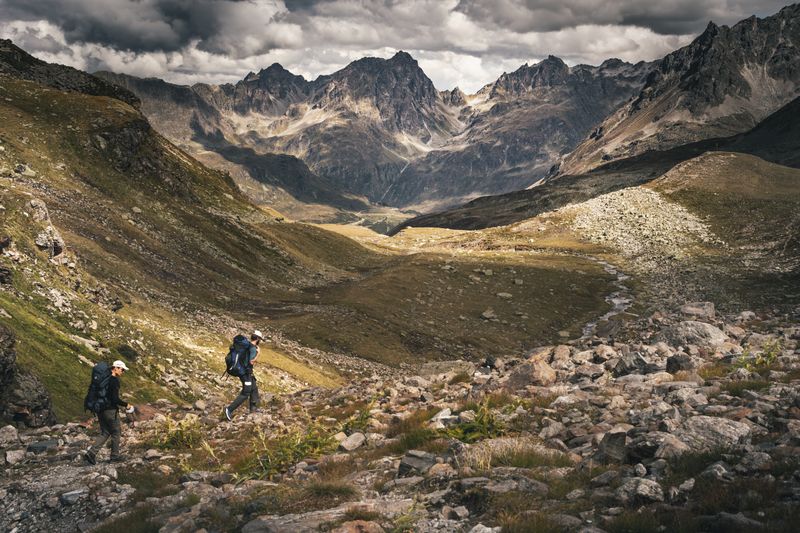
Upland terrain is organised as valleys separated by high ground. A natural walk goes up one and along the other, which is a line rather than a loop.
Closing the loop means crossing a col, descending an unfrequented flank or dropping to a valley floor and walking back, all of which add distance without adding much.
Where two valleys are joined by a usable pass at each end, an excellent circuit exists, and those configurations are uncommon enough that the resulting routes become famous.
Coasts and islands solve it geometrically
A peninsula or a small island produces a loop automatically, since the coast returns to itself. This is why coastal circuits are disproportionately good.
The same applies to any feature with a shape: a lake shore, a crater rim, a walled boundary. The circuit is inherent in the landform rather than imposed on it.
Route designers look for these first, and where none exists they generally accept a figure-of-eight or an out-and-back rather than forcing a poor loop.
Direction changes the walk substantially
A circuit walked clockwise and anticlockwise are different experiences, because ascent and descent are distributed differently and the sun and wind are met from opposite sides.
Steep ground is usually better ascended than descended, so a good route description specifies a direction and gives the reason rather than leaving it to preference.
Views also change. A circuit that faces the best ground on the return in the afternoon light is a considerably better walk than the same loop reversed.
Escape routes are the practical test
On a linear route, retreat means going back. On a circuit, the shortest way out changes at the halfway point, and beyond it continuing is faster than returning.
A well designed loop provides ways to cut it short at intervals, and identifying those before setting out is what makes a circular route a manageable choice in uncertain weather.
Questions readers ask
Do I need to break in modern boots?
Most trail shoes need little breaking in; your feet still need conditioning. Walk in the exact shoes and socks you will use, at the load you will carry.
Are double-layer socks worth it?
For people who blister reliably, often yes — they move the shear between the sock layers rather than against skin. They are warmer and bulkier, which suits some conditions and not others.
Also by Imogen Vasse
- Crofting, commons and the land nobody quite ownsPeople & Place
- Walking in heat is a different sport, and the rules are strictTrails & Routes
- Wild camping law varies enormously, and assumptions travel badlyTrails & Routes
- Pacing uphill: the conversation test beats any heart rate zoneTrails & Routes