Slow Travel
Long-distance cycling on trains, and the rules that vary by carriage
Combining rail and bicycle unlocks enormous range, and the rules differ by country, by operator and by service.
Everything below about taking bikes on trains comes from what actually happens rather than from what is supposed to.
What holds up in practice
- Reservation requirements for bicycles vary by operator and are often compulsory.
- Bagged folding bikes are usually carried as luggage without restriction.
- Regional services are far more accommodating than high-speed ones.
The variation is the difficulty
Rules differ between countries, between operators in the same country and between service types on the same line. Some services carry bicycles free without reservation; others require a paid reservation booked well ahead with very limited spaces.
Checking each leg individually is unavoidable and is what makes this look harder than it is. The definitions vary as much as the rules, since tandems, trailers, cargo bikes and sometimes e-bikes are separately excluded or charged, and an operator that carries bicycles freely may still refuse the particular machine you turn up with.
Regional trains are the friendly ones
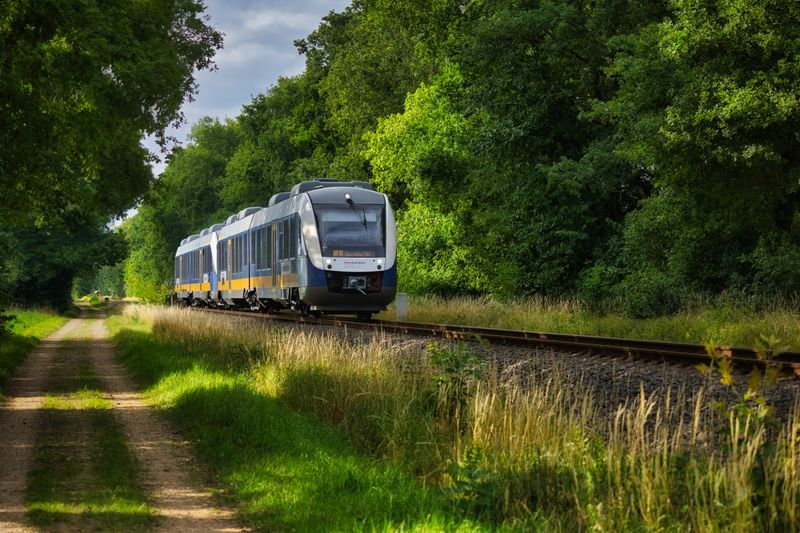
Local and regional services usually have generous, unreserved bicycle space and are the backbone of any rail-and-bike trip. High-speed services are the restrictive ones, frequently requiring dismantling, bagging or an advance reservation. Routing along regional lines is slower and vastly simpler.
Unreserved space is first-come rather than unlimited, and on a fine summer weekend the bike area of a regional train fills at the first station, which makes the early service worth considerably more than the convenient one.
Folding bikes bypass most of it
A folded bicycle in a bag is generally treated as luggage and carried without reservation or charge. That removes the entire planning problem at the cost of a smaller-wheeled, less comfortable bicycle. For anyone combining rail and riding frequently, it is a serious option.
In practice, the rule usually specifies bagged rather than merely folded, and that distinction decides whether the machine travels free as luggage or is turned away at the door, so the cover is not an accessory but the part that makes the arrangement work.
Practical realities
Bicycle spaces are often at one end of the train, and knowing which end saves a sprint along a platform. Loading hooks that hang a bicycle vertically are common and are awkward with a loaded machine, so panniers usually come off. Peak-hour restrictions apply on many commuter networks.
Bicycles also move in transit and fall against each other on curves, so a short strap to secure the machine to the rail costs nothing and prevents the bent derailleur that is the usual damage on a busy service.
Booking and connections
Where reservations are compulsory, they sell out long before the seats do on popular routes. Tight connections are riskier with a bicycle because loading takes time.
The detail that matters: building in longer transfers is worth more than saving thirty minutes on paper. The bicycle reservation is often a separate ticket with its own reference rather than a line on yours, and being unable to produce it at the door is treated as not holding one, so it is worth downloading rather than trusting an app and a signal.
The exception is usually weather, which overrides most planning.
The failure modes, and the fallbacks
Rail replacement buses during engineering work almost never carry bicycles, and the substitution is often announced too late to rebook, which is the commonest way a rail-and-bike plan collapses. A cancelled service with a compulsory bicycle reservation does not simply move that reservation to the next train, because the spaces on it were sold weeks earlier.
Over a season, where an operator runs a registered luggage or separate bicycle-carriage service, sending the machine ahead a day or two costs little and removes the problem entirely for the awkward legs. Ferries, regional buses fitted with rear racks and local taxi firms that keep a bike rack are the usual improvised fallbacks, and knowing which of them exists along your route is ten minutes well spent before departure.
The takeaway
Route along regional lines, book bicycle spaces early, and leave long connections.
Go slowly enough to notice, and most of this stops being advice and starts being obvious.
Questions readers ask
Can I take a bike on any train?
No. Rules vary by operator and service type, and compulsory reservations with limited spaces are common on long-distance and high-speed services.
Is a folding bike a real bicycle for touring?
For moderate distances on reasonable surfaces, yes. For long days on rough terrain, a full-size machine is considerably more comfortable.