Slow Travel
Coming home slowly is the half of the journey people cut
Travellers spend weeks planning the outward trip and book the fastest possible return. The asymmetry is worth examining.
This is written to be used rather than admired. Each section below is a decision about the journey home, and each one has a default.
Before you start
- The return leg is usually planned as a transfer rather than as part of the trip.
- A slow return provides a transition that a fast one removes entirely.
- Return legs are more vulnerable to disruption because they end at a fixed obligation.
The asymmetry in how trips are planned
Outward journeys get attention because they are full of unknowns, while return journeys are treated as administration and booked for the shortest duration available. That produces a common pattern: a considered arrival taking several days, and a departure compressed into the fastest connection that exists. The reasoning is usually about work, and the constraint is often real, but it is rarely examined as a choice rather than a given.
The consequence is that the trip ends abruptly, and the last thing experienced is a terminal rather than the place you travelled to see. Anyone who has taken a slow return knows the difference is not sentimental; it changes what the trip is afterwards.
What the return leg is actually for
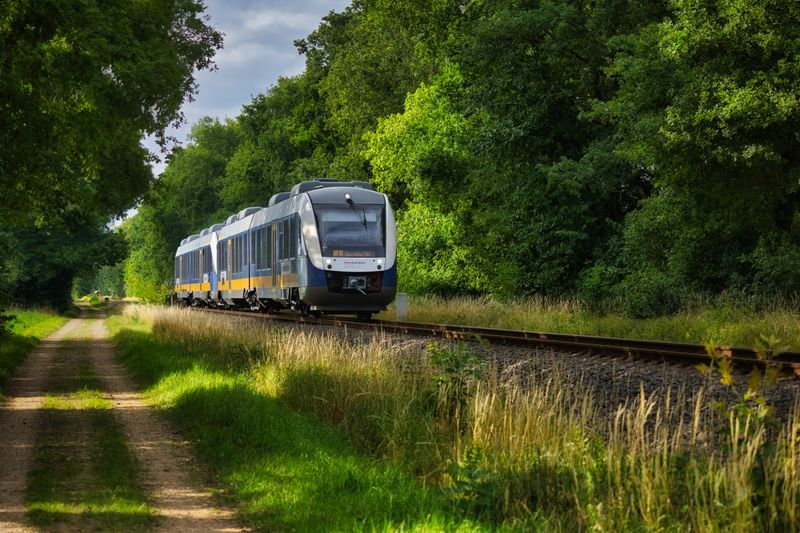
A long journey home provides an interval in which recent experience settles, which is the same function a walk-out provides at the end of a long trek. Reading, writing, sorting photographs and simply looking out of a window all happen naturally on a train and essentially never in an airport. The transition also matters practically, since arriving home directly from a remote place with no adjustment period tends to produce a flat few days.
For anyone who has been walking daily, a slow return maintains some continuity of movement rather than ending it in a single afternoon. None of this requires the journey to be scenic, though it usually is, and the value comes from duration rather than from the view.
Returns are structurally riskier
An outward delay costs you part of a holiday; a return delay costs you an obligation, which is why the same disruption feels entirely different. That makes margin more valuable on the way back, and it argues against the tightest possible connections precisely where people usually accept them. Ending a trip in a place with good onward links, rather than in the most remote spot reached, removes a great deal of that exposure.
A spare day at the end is the single most effective insurance, and it is also the day most likely to be cut when the trip is being planned. Where flights, ferries or seasonal services are involved, current schedules and conditions should be confirmed close to the date rather than trusted from booking.
Building a return that is part of the trip
Breaking the journey with a night somewhere en route converts a long transfer into a short one plus a place you would not otherwise have visited. Choosing a different route home from the outward one adds new ground for no extra time, which is the cheapest expansion of a trip available. Ferries and night trains work particularly well as returns, since a night spent travelling costs neither a day nor a room.
Locally, ending with a short walk rather than a long drive gives the trip a shape, and it is often possible with very little rearrangement.
The general principle is to treat the return as a leg with its own content rather than as the absence of the trip.
The luggage and logistics of going back
Returning is usually heavier and messier, with wet kit, accumulated items and less energy for organising any of it. That argues for a simpler return itinerary rather than a more ambitious one, and for fewer changes rather than more.
Worth knowing before you go — laundry, food and drying opportunities are worth building into the last day or two, because they make the journey itself considerably more pleasant. Where equipment must be posted, stored or handed back, doing it before the last day removes the commonest source of return-day chaos. These are small logistics and they determine whether the final leg is restful or is spent managing a rucksack that no longer closes.
None of this is uniform across a country the size of most of these.
When speed is the right answer
Some returns genuinely should be fast, including any trip where illness, injury or a family obligation makes getting back the only priority. Long-haul distances make a slow return impractical for most people, and pretending otherwise is a luxury argument rather than a travel one. Cost also cuts both ways, since a slow return may require additional nights that outweigh any saving on the ticket.
The detail that matters: the point is not that slow is always better but that the return leg deserves the same deliberate decision as the outward one. Made deliberately, a fast return is fine; made by default, it usually removes the best part of the last day for no reason anyone examined.
The takeaway
Plan the way back with the same care as the way out. It is half the trip and it is where the trip becomes a memory.
Go slowly enough to notice, and most of this stops being advice and starts being obvious.
Questions readers ask
Why bother with a slow return?
It provides a transition, keeps some continuity after an active trip and adds ground you would not otherwise see. It also builds in margin where disruption costs most.
What is the single best change to a return leg?
A spare day at the end. It absorbs disruption, removes the tightest connections and turns the last day from a transfer into part of the trip.
Should I take the same route home?
A different route adds new ground at no extra cost in time. It is one of the few free improvements available in travel planning.