Conservation
Planting trees is the easy half of making a wood
Getting saplings into the ground is a photograph. What happens over the following twenty years is the actual project.
These are listed in the order worth acting on, which with tree planting schemes is not the order they are usually presented in.
What matters most
- Establishment rate, not planting number, is what determines whether a wood exists in a decade.
- Browsing pressure is the commonest reason young trees fail on open ground.
- Natural regeneration is often cheaper and more successful where a seed source is nearby.
Planting and establishing are different achievements
The number of trees put into the ground is easy to count, easy to publicise and almost useless as a measure of whether a woodland will exist later. What matters is survival through the first few years, when a sapling has a small root system and no ability to compete for water or light. Losses in that period are normal and expected, which is why planting densities allow for failure and why a reported figure of trees planted overstates the outcome.
Projects that report survival after several seasons are telling you something meaningful; projects that report only planting numbers are telling you about an event. That distinction explains most of the disagreement about large tree-planting commitments, since the commitments are usually written in the units that are easiest to hit.
The ground decides more than the species list
Soil depth, drainage, exposure and existing vegetation determine what will grow, and no amount of planting effort overrides a fundamentally unsuitable site. Planting on deep peat has been widely criticised, because drainage for the trees can release more stored carbon than the growing trees will capture.
Dense grass competes fiercely for water and can smother small trees entirely, which is why ground preparation is often the largest cost in a scheme. Waterlogged ground kills roots of most species, while very free-draining ground exposes young trees to drought in the first hot summer. Matching species to site conditions is unglamorous work and it is the difference between a wood and a field of dead tubes.
Something will eat them
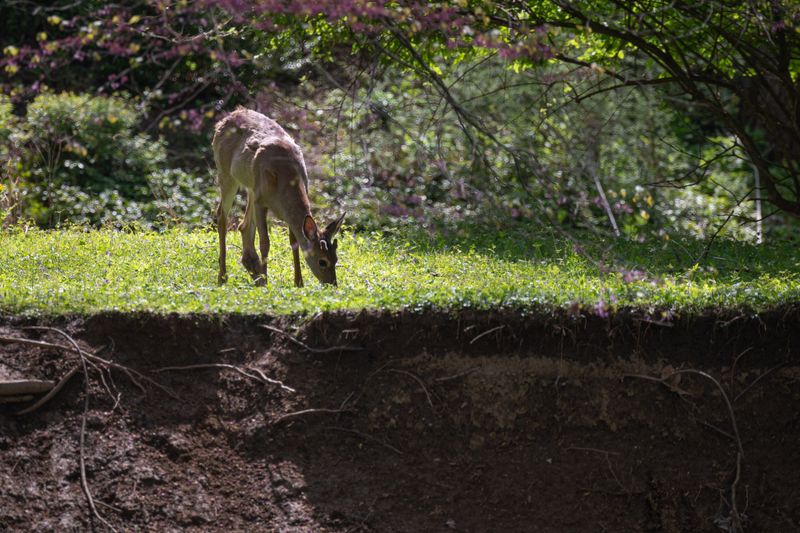
Deer, rabbits, hares, voles and livestock all browse young trees, and in many landscapes browsing pressure is the single decisive factor in establishment. Repeated browsing does not always kill a sapling outright; it keeps it short for years, which is functionally the same outcome for a woodland scheme.
Protection options are fencing, individual guards or reducing the browsing population, and each carries costs and objections of its own. Fencing is expensive, needs maintenance, blocks the movement of other animals and can simply concentrate browsing pressure outside the fence. Culling is effective and contested, and the debate about it is really a debate about who has the right to decide what a landscape should look like.
Tubes, guards and the plastic problem
Individual tree guards protect from browsing and create a warm sheltered microclimate that accelerates early growth, which is why they became standard. They also require removal, and abandoned guards degrade into plastic fragments that persist in soil and watercourses for a very long time.
Locally, alternatives include biodegradable guards, which vary in how completely they break down, and schemes designed to avoid guards through fencing or lower browsing pressure. Whatever is used, the maintenance obligation runs for years, and it is the obligation most often dropped when a project's funding period ends. A wood full of split guards on dead stems is a common sight and a fair summary of what happens when planting is funded and aftercare is not.
The case for letting it happen
Where a seed source exists nearby and browsing can be controlled, natural regeneration produces woodland at a fraction of the cost of planting. Naturally regenerated trees establish where conditions suit them, which produces uneven, patchy woodland that is structurally richer than an evenly planted block. It also avoids the risk of importing pests and diseases with nursery stock, which has been a serious problem for several tree species in recent decades.
The drawback is time and unpredictability, since regeneration may take decades and may not produce the species mix a funder specified. The practical answer at many sites is a mixture: plant sparingly to create a seed source and structure, then let the wood fill in around it.
Judging a scheme from outside
Ask what the site was before, because converting species-rich grassland or peat into woodland trades one habitat for another rather than adding one. Ask who maintains it and for how long, since the funding period and the establishment period are frequently different lengths. Ask whether the trees are protected from browsing and how, because a scheme without an answer to that question is unlikely to produce a wood.
Over a season, where carbon is claimed, ask over what timescale and with what allowance for losses, as young trees store relatively little for the first years. These questions are not hostile; they are the same questions the people running good schemes ask themselves, and they generally have answers ready.
Everything above, in order of what to do first
- Planting and establishing are different achievements. The number of trees put into the ground is easy to count, easy to publicise and almost useless as a measure of whether a woodland will exist later.
- The ground decides more than the species list. Soil depth, drainage, exposure and existing vegetation determine what will grow, and no amount of planting effort overrides a fundamentally unsuitable site.
- Something will eat them. Deer, rabbits, hares, voles and livestock all browse young trees, and in many landscapes browsing pressure is the single decisive factor in establishment.
- Tubes, guards and the plastic problem. Individual tree guards protect from browsing and create a warm sheltered microclimate that accelerates early growth, which is why they became standard.
- The case for letting it happen. Where a seed source exists nearby and browsing can be controlled, natural regeneration produces woodland at a fraction of the cost of planting.
- Judging a scheme from outside. Ask what the site was before, because converting species-rich grassland or peat into woodland trades one habitat for another rather than adding one.
The takeaway
Count the trees standing after ten years, not the ones planted on the first morning.
What holds up over a week outdoors is rarely what looks best at the trailhead.
Questions readers ask
Why is planting on peat criticised?
Draining peat to plant trees exposes stored carbon to decay. The loss can exceed what the trees capture, and the peatland habitat is lost as well.
Are tree guards necessary?
They are one answer to browsing. Fencing or lower browsing pressure are others. Where none of the three is in place, most schemes on open ground fail.
Is natural regeneration always better?
It is often cheaper and more resilient where a seed source is close and browsing is controlled. It is slower and less predictable, which does not suit every objective.