Gear & Craft
Waterproof boots are the wrong answer more often than people think
A membrane keeps water out until it comes over the top, and then keeps it in for the rest of the day.
This is written to be used rather than admired. Each section below is a decision about waterproof footwear, and each one has a default.
Before you start
- Membranes fail at the ankle opening, not through the material.
- Non-waterproof shoes drain and dry within hours.
- Warm, wet conditions favour drainage over waterproofing.
Water enters over the cuff
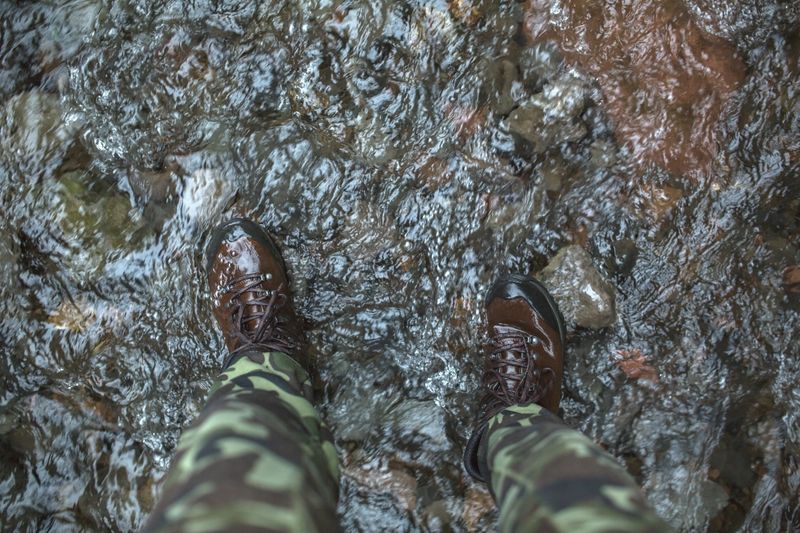
In sustained rain, water runs down the leg and into the boot regardless of the membrane. Deep puddles and stream crossings do the same thing faster.
Once inside, a waterproof boot holds the water in, because the membrane works in both directions. A wet lined boot also dries far more slowly, since the membrane blocks evaporation from the inside exactly as it blocks rain from the outside, so a soaking on the second day of a trip is still with you on the fourth.
Drainage is the alternative
A non-waterproof trail shoe wets through immediately and drains and dries within a couple of hours of walking. In warm wet conditions or on routes with repeated crossings, that cycle is far more comfortable than a boot full of water.
This is why many long-distance walkers in wet climates deliberately choose non-waterproof footwear. The cost is that everything else gets in as well, so mesh shoes ship grit and need rinsing out, and skin kept wet for days softens and macerates, which is why people who walk this way treat a dry pair of evening socks as non-negotiable.
Where membranes earn their place
Cold conditions, snow, short wet grass and day walks where you return to dry footwear all favour a membrane. Keeping feet dry in cold weather is a genuine safety matter rather than a comfort preference. Winter and mountaineering boots are a different category again.
Below freezing it stops being a preference at all, because wet feet in sub-zero conditions are a frostbite risk rather than a discomfort, and that single fact keeps membranes in winter boots regardless of everything else against them.
Gaiters change the calculation
Gaiters seal the gap between trouser and boot and address the actual failure point. A waterproof boot with gaiters is a coherent system; a waterproof boot without them frequently is not.
Locally, they also keep out grit, snow and seeds, which matters more than people expect. Fit is what decides whether they work at all, since a gaiter that gapes at the boot or rides up the calf channels water inwards, and the underfoot strap is the part that wears through first and is worth checking before a trip rather than during one.
Socks do more than the boot
Wool or synthetic socks retain warmth when damp; cotton does not and should be avoided entirely. Carrying a dry pair for the evening is the single most effective comfort measure on a multi-day trip. Waterproof socks exist and work reasonably as a middle option, with the same over-the-top limitation.
Sock thickness also changes the fit enough to matter, so a boot tried on with thin shop socks and then walked in with thick winter ones is effectively a different boot, which is why the socks you intend to use belong at the fitting.
Membranes stop breathing before they stop being waterproof
A membrane only passes water vapour outwards while the outer fabric is dry; once that face wets out and holds a film of water, the gradient collapses and the boot behaves as though it were sealed. Mud, sweat salts and the oils from a leather upper clog the outer face just as effectively as rain, which is why an unwashed boot breathes noticeably worse than a clean one.
Locally, even working perfectly, a membrane moves far less moisture than a foot produces on a hard climb, so damp feet on a strenuous day are the normal outcome rather than a fault. Cleaning the uppers and reproofing the outer surface restores most of the lost performance, and takes an evening rather than the price of new boots.
The takeaway
Decide whether you want water kept out or let out. Both are valid; only one can be true.
The route rewards patience more than equipment.
Questions readers ask
Should I buy waterproof boots for hillwalking?
In cold or snowy conditions, generally yes. In warm wet conditions with frequent crossings, drainage often beats waterproofing.
Do gaiters really help?
They address the actual entry point, which is the cuff. With a waterproof boot they make the system work; without them the membrane is doing half a job.