Gear & Craft
Grip is rubber, tread and what lies underneath
Every claim about a sole depends on the surface it meets. Understanding why grip fails is more useful than believing any compound is best.

Everything here earned its place by changing an outcome. Nothing about boot grip is included to round the number up.
What matters most
- Soft rubber grips smooth rock better and wears out faster; hard rubber does the reverse.
- On soft ground, grip comes from lugs digging in rather than from the rubber itself.
- Wet vegetation, wet smooth rock and mud each defeat different aspects of a sole.
Two different mechanisms called by one name
On hard surfaces such as rock, grip comes from friction between rubber and stone, and it depends on how well the compound conforms to microscopic roughness. On soft surfaces such as mud, snow or loose soil, friction with the rubber is almost irrelevant and grip comes from lugs penetrating and shearing against the material. Because these are different mechanisms, no single sole optimises both, and every design is a compromise between them rather than an achievement of both.
A deep aggressive tread that excels in mud performs poorly on smooth rock, since it presents very little contact area to a surface that rewards contact area. A flat sticky sole that excels on rock is close to useless on a wet grassy slope, where there is nothing for friction to work against.
What compound actually means
Rubber compounds vary in hardness, and softer compounds deform more readily into surface irregularities, which increases friction on hard smooth surfaces. The cost is durability, since softer rubber abrades faster, and a sole optimised for grip on rock will wear noticeably quicker on gravel tracks.
Worth knowing before you go — hardness also changes with temperature, and most compounds stiffen in cold, which is why grip on cold wet rock is worse than the same rock in summer. Manufacturers publish compound names rather than numbers, so comparison between brands is mostly impossible from the information provided. The practical test is how a sole behaves on the surfaces you actually walk on, in the conditions you actually meet, rather than what the label claims.
Tread pattern is a drainage problem
Lugs need space between them to shed mud, because a sole packed solid with mud is effectively a smooth sole with worse contact. Widely spaced lugs clear better and reduce total contact area, which is the same trade-off appearing again in a different form.
Edges matter as much as depth, since a sharp lug edge bites into firm ground while a rounded worn one slides over it. A defined heel breast helps on steep descent by giving something to brake against, which is why running shoes and walking boots differ there. Channels that direct water away from the contact area reduce the film of water that separates rubber from rock, which is the mechanism behind wet grip loss.
The surfaces that catch people out
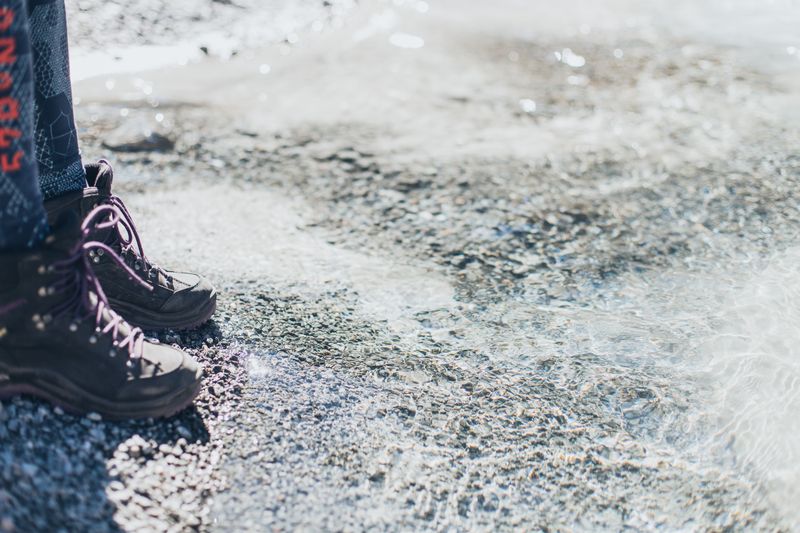
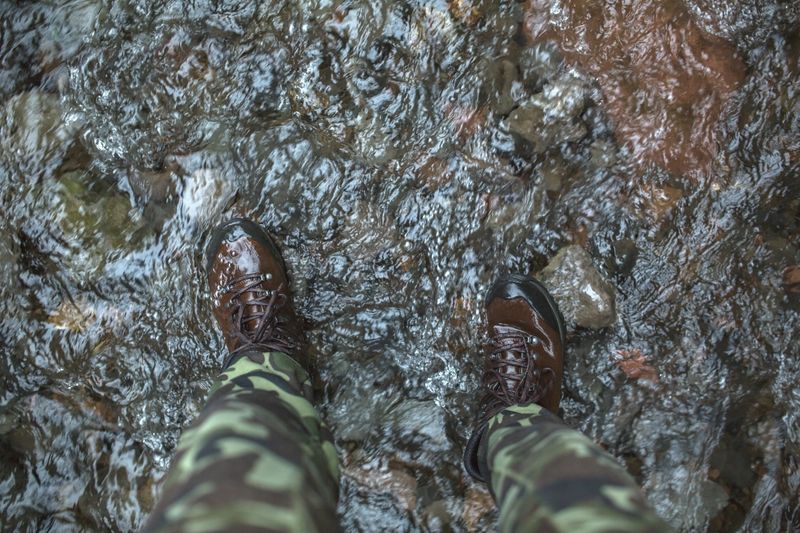
Wet smooth rock, particularly polished limestone and some volcanic rock, is the classic failure, because a water film prevents the rubber contacting the surface. Wet grass on a slope is worse than mud in many cases, since the vegetation shears against itself and no lug depth reaches anything solid.
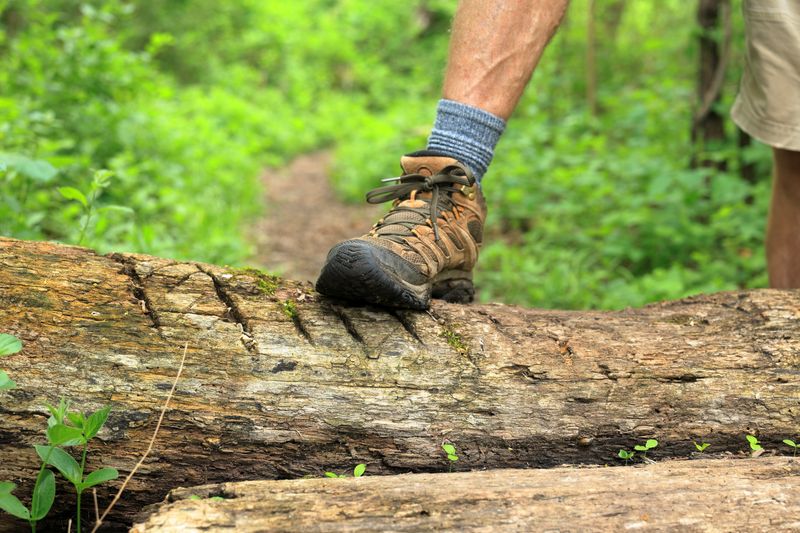
Over a season, wet wood, whether a boardwalk, a stile or a fallen trunk, is unreliable in a way that surprises people every year, and algae makes it worse. Loose gravel on hard rock behaves like ball bearings, defeating both mechanisms at once because nothing penetrates and nothing grips. Snow and ice require different equipment entirely, and no walking sole is a substitute for traction devices where they are needed.
Wear changes the boot underneath you
Soles wear unevenly, usually at the outer heel and the ball, which changes the angle at which the foot meets the ground before the tread has visibly gone. Lug edges round off long before lug depth disappears, so a sole can look serviceable and grip considerably worse than it did when new.
In practice, midsole cushioning compresses over time as well, which affects stability and shock absorption without being visible from outside. Rubber hardens with age even when unused, so old stock and long-stored boots grip less well than their condition suggests. Checking the outer edges of the heel and the sharpness of the lugs is a better assessment than checking whether the tread pattern is still there.
That varies by region, and it is worth checking locally.
Choosing for the ground you actually cross
A person walking mostly on maintained paths, gravel and dry hills is best served by a durable harder compound and a moderate tread. Someone regularly on wet rock, scrambling ground or steep grassy hillsides gains a lot from a softer stickier compound and accepts faster wear.
Peat, bog and farmland argue for depth and spacing above everything else, since mud shedding is the constraint that matters there. Mixed ground is genuinely a compromise, and most walkers end up owning more than one pair rather than finding a sole that does everything. Whatever is chosen, technique matters as much as rubber: weight placed vertically over the foot grips better than weight leaning into the hill.
Everything above, in order of what to do first
- Two different mechanisms called by one name. On hard surfaces such as rock, grip comes from friction between rubber and stone, and it depends on how well the compound conforms to microscopic roughness.
- What compound actually means. Rubber compounds vary in hardness, and softer compounds deform more readily into surface irregularities, which increases friction on hard smooth surfaces.
- Tread pattern is a drainage problem. Lugs need space between them to shed mud, because a sole packed solid with mud is effectively a smooth sole with worse contact.
- The surfaces that catch people out. Wet smooth rock, particularly polished limestone and some volcanic rock, is the classic failure, because a water film prevents the rubber contacting the surface.
- Wear changes the boot underneath you. Soles wear unevenly, usually at the outer heel and the ball, which changes the angle at which the foot meets the ground before the tread has visibly gone.
- Choosing for the ground you actually cross. A person walking mostly on maintained paths, gravel and dry hills is best served by a durable harder compound and a moderate tread.
The takeaway
There is no best sole. There is a sole matched to the ground you cross most often, and a technique that keeps weight over it.
What holds up over a week outdoors is rarely what looks best at the trailhead.
Questions readers ask
Why do my boots slip on wet rock?
A film of water prevents the rubber contacting the surface, and cold stiffens most compounds. Polished rock, algae and worn rounded lugs all make it worse.
Are deep lugs always better?
No. They help on soft ground by penetrating it, and reduce contact area on rock where contact area is what provides friction. It is a trade, not an upgrade.
When should boots be resoled or replaced?
When lug edges have rounded off or the heel has worn unevenly, rather than when the pattern has finally disappeared. Midsole compression is a separate and invisible issue.